Multiple Indicator Cluster Survey (MICS) 2025
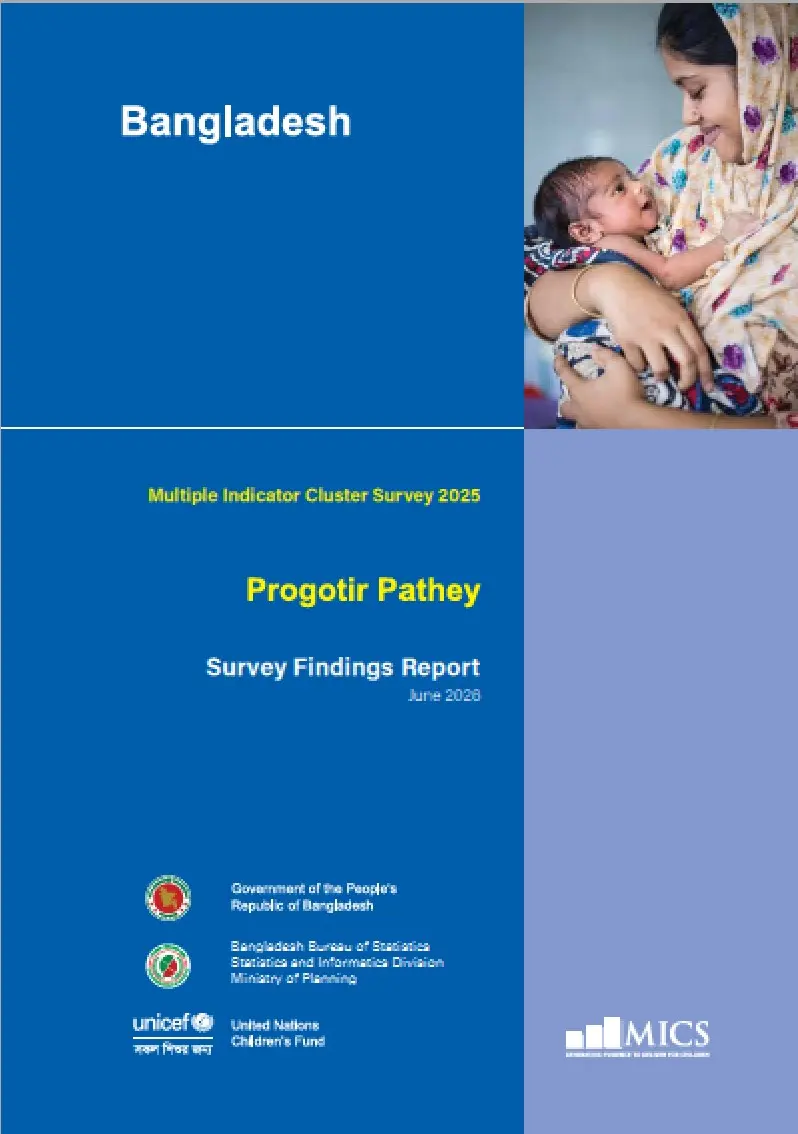
Dhaka, 27 July 2026: The Bangladesh Bureau of Statistics (BBS), under the Statistics and Informatics Division, Ministry of Planning, has published online the final report of the Bangladesh Multiple Indicator Cluster Survey (MICS) 2025, titled “Progotir Pathey”.
Implemented by BBS in collaboration with UNICEF, MICS 2025 provides nationally and internationally comparable evidence on the situation of children, women and households in Bangladesh. The survey covered 3,149 primary sampling units and 62,980 sampled households, of which 61,207 households were successfully interviewed, achieving a response rate of 99.6 percent. It provides representative estimates at the national, urban–rural, divisional and district levels, as well as for Dhaka North, Dhaka South and Chattogram City Corporations.
The final report presents 173 indicators, including 27 indicators directly linked to the Sustainable Development Goals. It covers child survival, maternal and newborn health, nutrition, education and foundational learning, child protection, birth registration, child labour, child marriage, water, sanitation and hygiene, social protection, disability and reproductive agency. For the first time in Bangladesh MICS, the survey also provides extensive evidence on blood lead levels and other heavy metals among young children and pregnant women.
Key findings
- The under-five mortality rate declined to 33 deaths per 1,000 live births, compared with 39 during the period 10–14 years preceding the survey. The neonatal mortality rate stands at 22 deaths per 1,000 live births, indicating that newborn survival remains a major policy priority.
- 71.0 percent of recent births took place in a health facility. However, substantial socioeconomic and geographic disparities remain: facility delivery ranged from 52.6 percent among women in the poorest wealth quintile to 86.9 percent among those in the richest quintile.
- Only 59.2 percent of children under five had their births registered with civil authorities, meaning that more than two in every five young children remained without birth registration at the time of the survey.
- Among children aged 7–14 years, 50.2 percent demonstrated foundational reading skills. Girls performed better than boys, with corresponding rates of 54.5 percent and 45.6 percent.
- 9.1 percent of children aged 5–17 years were engaged in child labour under the MICS/SDG definition. Child labour was notably higher among children from poorer households and among children who were not attending school.
- Access to at least basic drinking water was high at 98.6 percent. Nevertheless, water safety remains a serious concern: 85.0 percent of household members were using drinking water contaminated with E. coli at the point of consumption. Basic handwashing service was available to 68.6 percent and basic sanitation service to 72.9 percent of the population.
- Blood testing found that 38.4 percent of children aged 12–59 months had blood lead levels of at least 5 micrograms per decilitre. The prevalence was considerably higher in urban areas and among children living near industrial and lead-related activities.
The findings demonstrate important national progress, particularly in child survival, access to health facilities and basic services. At the same time, they highlight continuing challenges relating to newborn mortality, quality of maternal health care, birth registration, foundational learning, child protection, safe drinking water and exposure to environmental hazards.
MICS 2025 will provide a critical evidence base for government ministries and agencies, local government institutions, development partners, researchers and civil society organizations. The district-representative results will support more targeted planning, equitable resource allocation and monitoring of national priorities and the Sustainable Development Goals.
Download See Resource File